
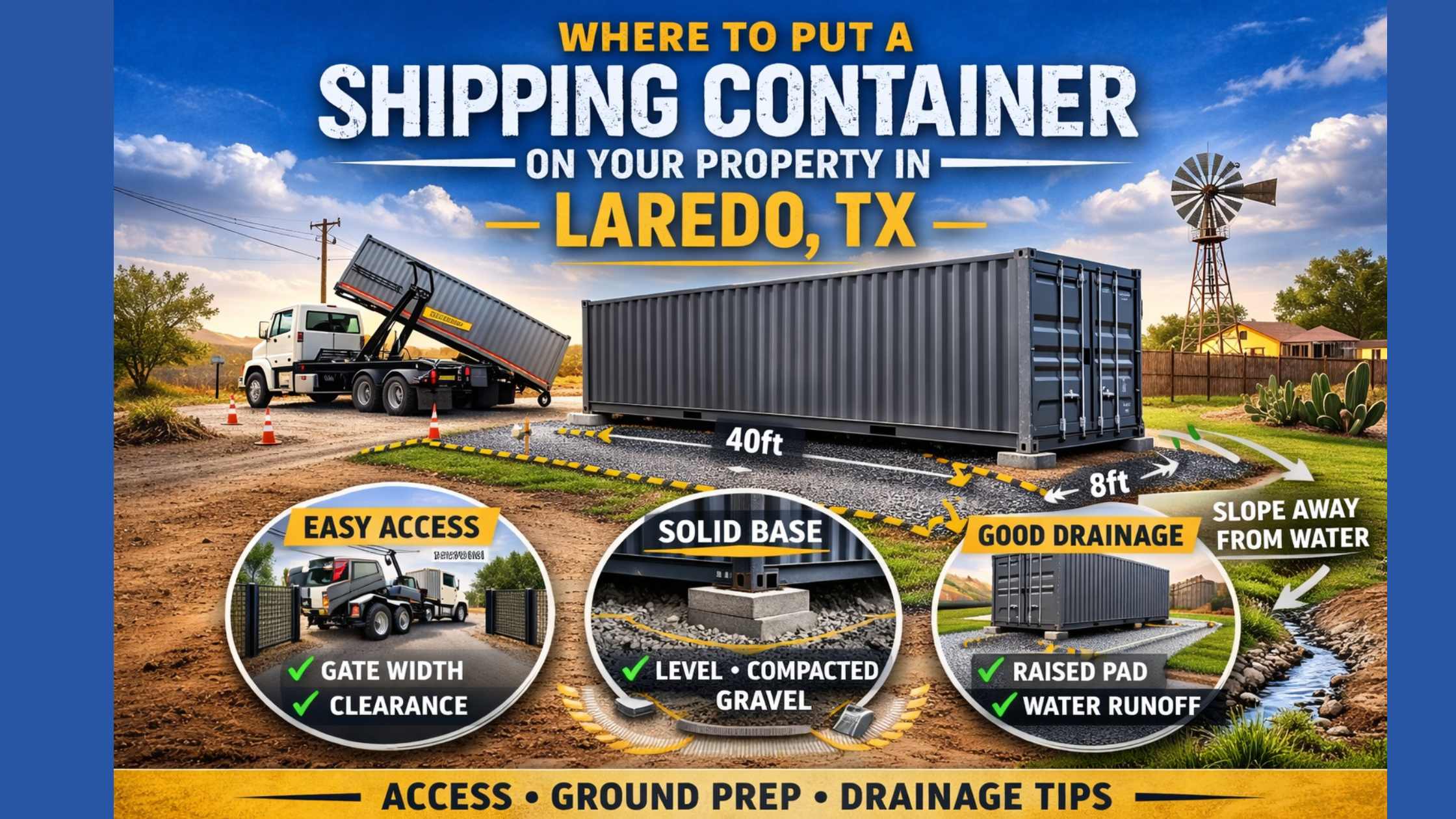
A shipping container can be the most secure, weather-resistant storage you’ll add to your property—if it’s placed correctly. In Laredo, the big three that make or break a smooth install are:
- Access for delivery (turning radius + overhead clearance)
- Ground prep (level, compact, stable base)
- Drainage (avoid pooling water and flood-prone areas)
Below is a practical, Laredo-specific guide you can use whether you’re placing a 10ft, 20ft, or 40ft container for a home, ranch, jobsite, or business yard.
1) Start with access: can the delivery truck actually reach the spot?
Before you fall in love with “the perfect corner,” think like a driver. Container delivery typically requires a truck to approach, line up, and unload with enough room to pull forward and exit cleanly.
Access checklist (quick wins)
- Clear the route from street to placement spot (vehicles, equipment, loose debris).
- Measure gate openings and tight turns (especially common in older neighborhoods and narrow side yards).
- Check overhead clearance for tree limbs, service drops, and utility lines.
- Plan the “drop direction.” The driver needs room to set the container down straight.
Local tip: If you’re near high-traffic corridors (think Loop 20 / Bob Bullock Loop or I-35 frontage), plan for a delivery window that avoids peak congestion so the truck isn’t forced into rushed maneuvers.
2) Choose a spot that stays dry (drainage matters more than people think)
In South Texas, a container’s #1 long-term enemy isn’t rain—it’s standing water that lingers after rain. Pooling water accelerates rust, encourages pests, and can shift an unprepared base over time.
What a “good drainage” spot looks like
- Naturally higher ground vs. low spots in the yard
- Water runs away from the container area after a storm
- No evidence of recurring puddles, soft soil, or erosion channels
Flood-zone awareness (especially near arroyos / low-lying areas)
The City of Laredo provides flood information mapping layers that can help you identify floodways and flood-prone areas before you commit to a location.
Best practice: If your property touches or sits near a drainage channel (natural or engineered), place the container outside areas that regularly collect runoff and give yourself a buffer.
3) Ground prep: the difference between “set it down” and “set it down right”
Shipping containers are rigid steel boxes. If they sit on uneven or unstable ground, you can end up with:
- Doors that stick or won’t seal properly
- Frame twist that stresses the container over time
- Sinking corners after heavy rain or repeated use
The goal: level + stable + supported at the corners
Most containers are designed to be supported at the corner castings. Your base should keep those corners stable.
Common base options in Laredo (from simplest to most robust)
- Compacted native soil (only if the ground is firm, well-draining, and you’re elevating corners properly)
- Road base / crushed limestone pad (very common for storage yards and ranch properties)
- Concrete pads / runners (best for long-term installs and frequent foot traffic)
Raise it slightly (yes, even a little helps)
A small elevation reduces contact with puddles and improves airflow. Even modest elevation can help with condensation and corrosion risk over time.
Pro tip: If you’re installing a long container (like a 40ft), “almost level” isn’t level. A small slope over 40 feet becomes a big problem at the doors.
4) Plan for Laredo storms: runoff control and site grading
If you’re doing a commercial or larger site setup, you’ll want to think beyond “my yard drains okay” and consider how improvements affect runoff.
The City of Laredo Engineering Department publishes stormwater guidance that’s relevant when grading, adding pads, or changing drainage patterns.
Rule of thumb: Don’t create a new “dam” that pushes water toward a neighbor, a driveway, or a building slab. If you’re adding a sizeable pad, consider a slight grade and a defined runoff path.
5) Keep it convenient: doors, workflow, and security
A container placed in the “perfect hidden spot” can be annoying if you’re using it daily.
Placement for real-world use
- Put the doors facing the direction you’ll approach most often (driveway, work area, loading zone).
- Leave enough space to fully swing doors open (and to walk around them).
- If you’ll load by handcart or pallet jack, keep the approach flat and firm.
Security placement tips
- Avoid placing doors directly facing the street if you don’t need to.
- Use lighting and visibility: “out of sight” is not always “more secure.”
- Consider add-ons like a lockbox (if offered) and a consistent locking routine.
6) Don’t skip zoning and permitting basics
Depending on how you use the container (temporary storage vs. permanent placement, commercial vs. residential, modifications, electrical, etc.), you may need to confirm zoning compliance or permits.
- The City of Laredo’s Building Development Services explains that permits are used to ensure work complies with zoning and building codes.
- The City also provides online tools for the building permit process (applications, scheduling inspections, etc.).
- City code language generally treats constructing/altering structures without proper permits as unlawful.
- For zoning, the City provides zoning resources and an official zoning map to identify district rules and permitted uses.
Practical takeaway: Before delivery, confirm:
- Your property’s zoning district
- Whether a container is treated as an accessory structure in your situation
- Any placement limits (setbacks, visibility, screening, etc.)
(If you’re outside city limits, Webb County planning resources may also be relevant depending on your exact location. )
7) Delivery-day checklist (use this to avoid delays)
Here’s a simple checklist our Laredo customers use to keep delivery smooth:
Before the truck arrives
- ✅ Clear the route: vehicles, gates unlocked, pets secured
- ✅ Mark the corners (spray paint or stakes)
- ✅ Confirm overhead clearance (trees + utility lines)
- ✅ Make sure the base is ready and level
- ✅ Confirm where doors should face
- ✅ Have a point-of-contact on-site
When the container is set down
- ✅ Verify doors open/close smoothly
- ✅ Check level (especially at the door end)
- ✅ Confirm drainage: water should not run toward the container
Ready to place a container in Laredo? We can help you choose the best spot.
At Laredo Container Services, we help customers match the right container size to their property and plan a placement that works for access, stability, and drainage. If you want, share:
- Your container size (10/20/40)
- A quick description of access (gate width, driveway type)
- Whether the spot is dirt, caliche, gravel, or concrete
…and I’ll turn this into a site-specific placement recommendation you can use before scheduling delivery.
FAQ
Do I need a permit to place a shipping container in Laredo?
Sometimes. It depends on your zoning, how long it will be there, and whether it’s considered a structure or involves improvements. The City of Laredo provides permit resources and zoning tools to help confirm requirements.
What’s the best base for a container in Laredo?
For many properties, a compacted road base pad (properly graded for drainage) is a strong balance of cost and performance. For long-term installs or heavy use, a concrete pad is often best.
How do I avoid water pooling around the container?
Pick higher ground, build a slightly raised base, and ensure runoff has a clear path. Use City flood mapping layers as a sanity check if you’re near low-lying areas.
No Comment